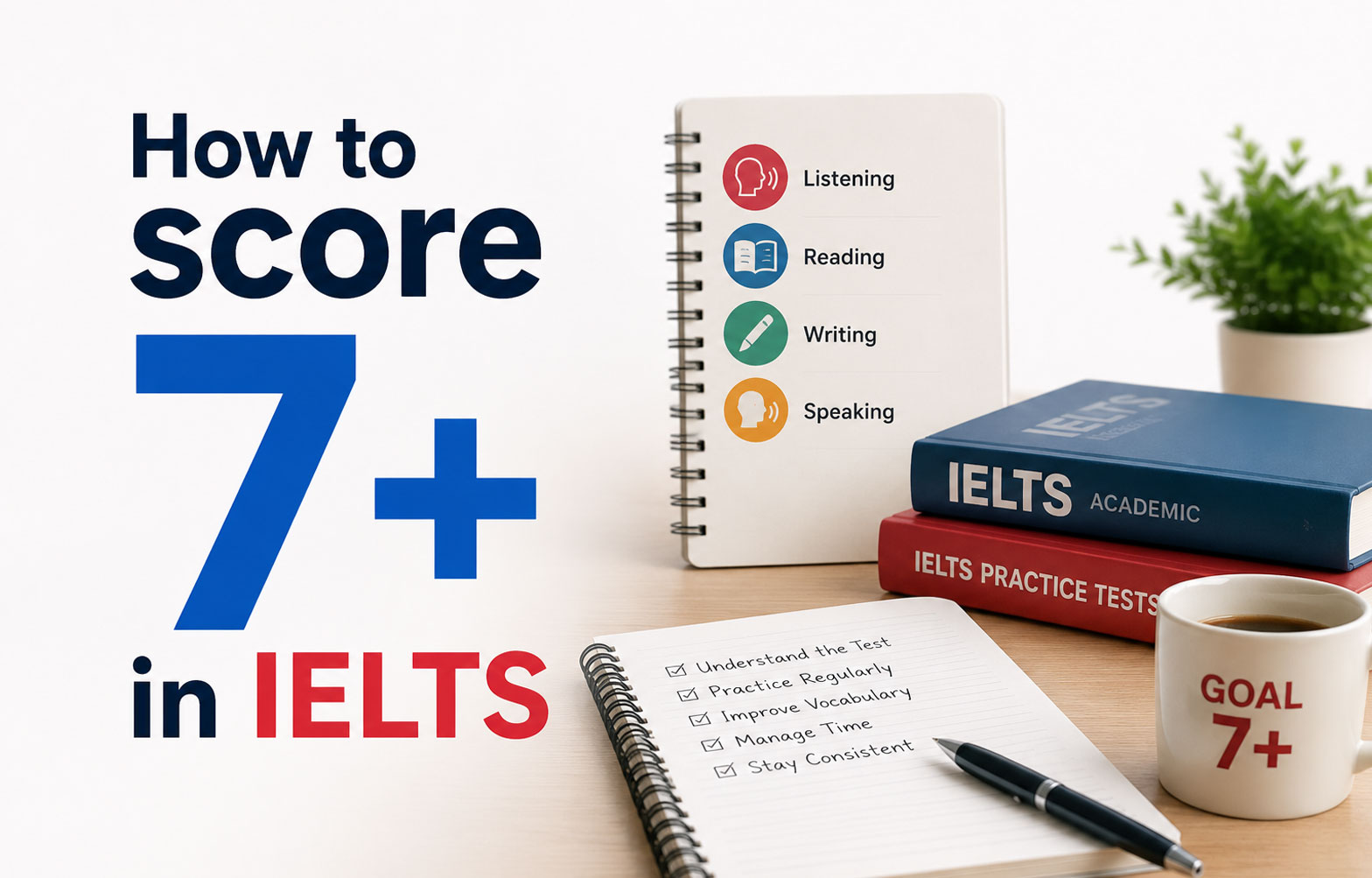
How to Score 7+ in IELTS: The Ultimate Preparation Strategy
Achieving a Band 7 or higher in the IELTS exam is a significant milestone for students and professionals aiming to move abroad. A Band 7 indicates a “good user” who has operational command of the language, despite occasional inaccuracies. Moving from a Band 6 to a Band 7+ requires transitioning from casual preparation to highly strategic, structured practice across all modules.
1. Decode the Marking Criteria
To hit a high band score, you must understand exactly how examiners grade your performance. For the Writing and Speaking modules, you are assessed on four major metrics: Lexical Resource (vocabulary), Grammatical Range and Accuracy, Coherence and Cohesion (logical flow), and Task Achievement. Simply writing long paragraphs will not work; your answers must be precise, grammatically sound, and directly address the prompt.
2. Master Receptive Skills (Listening & Reading)
Listening and Reading are the most high-yielding sections where you can easily push your overall average. For a Band 7+, you need to get at least 30 out of 40 questions right in both modules.
- Listening: Train your ear to understand various native accents (British, Australian, American). Always use the given reading time to underline keywords in questions and predict the type of answer required (e.g., a number, date, or noun).
- Reading: Stop reading every single word of the long passages. Instead, master the core micro-skills of skimming for the main idea and scanning for specific names, data, or technical terms to save valuable time.
3. Refine Productive Skills (Writing & Speaking)
The productive modules are where most candidates get stuck at a Band 6.5. Pushing past this barrier requires intentional vocabulary upgrades and structural control.
- Writing: Always allocate the first 5 minutes to plan your essay layout. Ensure Task 2 has a clear introduction with a thesis statement, well-developed body paragraphs with supporting examples, and a concise conclusion. Avoid repeating the same words; use varied synonyms naturally.
- Speaking: Fluency and confidence are more critical than using overly complex, forced vocabulary. Speak at a natural, steady pace, elaborate on your answers during the cue-card round, and use transitional phrases (e.g., “Furthermore”, “On the other hand”) to connect your thoughts cleanly.
4. Take Full-Length Simulated Mock Tests
Consistent, timed practice is the final piece of the puzzle. Taking isolated practice sections will not prepare you for the intense 3-hour exam environment. Take regular full-length mock tests to build your mental endurance, analyze your time leaks, and fine-tune your exam strategy before the real test day.
🚀 Ready to jump-start your preparation?
Maximize your testing potential with our expert-led classes, analytical mock tests, and personalized expert feedback at StudyEnglish123.com today!
